
In the world of clinical research, we are often told to pick a philosophical side. Are you a Positivist, hunting for numbers, objective, measurable truths and {p < 0.05}? Or are you an Interpretivist, seeking to understand the complex, subjective meanings behind human experiences? After years of navigating clinical trials and developing new research framework, I’ve realized the truth is more fluid. To be an effective researcher, you must possess a “Cognitive Duality”: You must design research as an interpretivist, but read it as a positivist.
The Design Phase: Why We Must Be Interpretivists in Research
When we start a new project, we aren’t just looking for numbers; we are looking for gaps in the human experience. When I began looking at access burdens in mental health, a purely positivist approach would have only looked at “time to appointment” or “distance to clinic.”
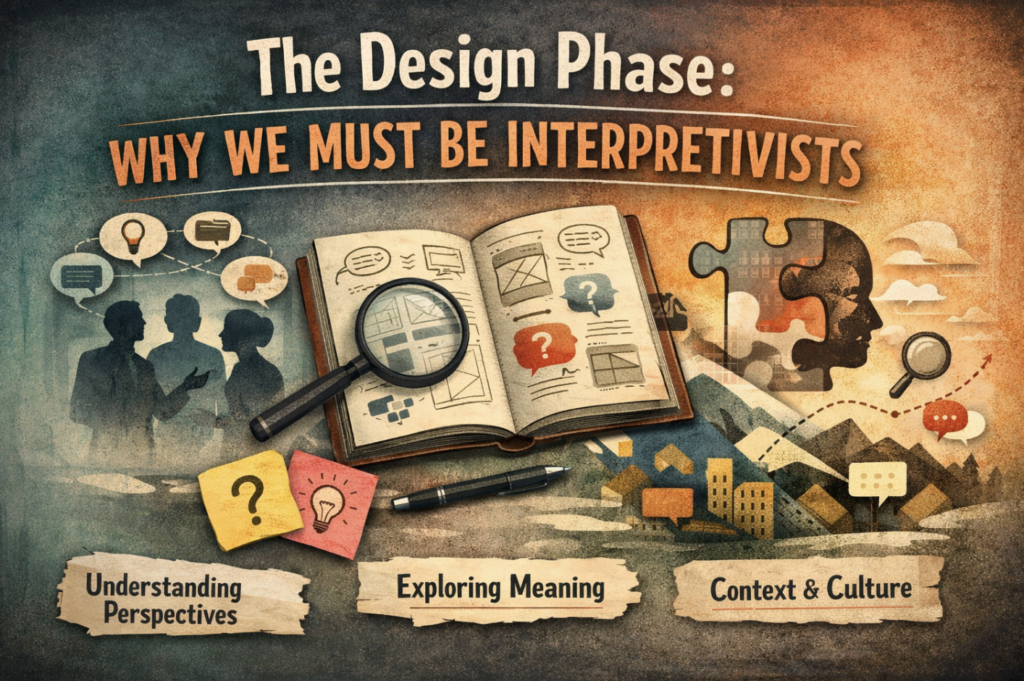
AI Generated Image
But as a researcher in the design phase, I had to be an interpretivist. I had to ask:
1. What does “access” actually feel like to a patient in crisis?
2. How do socio-economic layers construct a different reality for one patient versus another?
Designing research requires empathy and the acknowledgment that reality is socially constructed. If we don’t interpret the “why” and the “how” behind the patient’s journey, we risk building protocols that are mathematically perfect but clinically irrelevant (1).
The Reading Phase: Why We Must Shift to Positivism in Research
The moment I open a journal to review a literature search, whether it’s on driving fitness in dementia or a new psychiatric drug, my “Interpretivist Hat” comes off. I am no longer looking for “meaning”; I am looking for evidence.
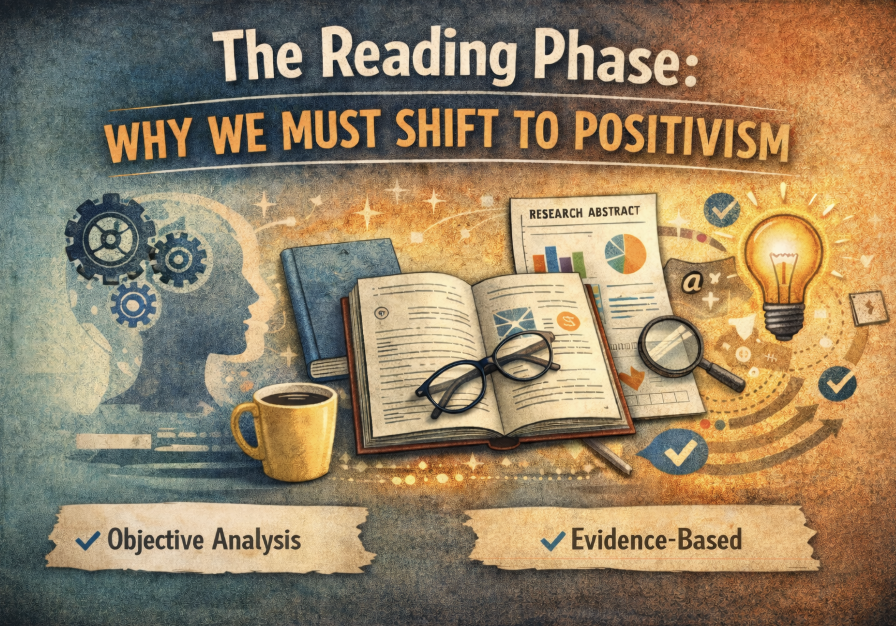
AI Generated Image
When consuming research, we must be positivists. We have to treat the data as an objective reality that must stand up to the cold light of scrutiny.
1. Is the sample size ({n}) large enough to generalize?
2. Are there confounding variables that weren’t controlled?
3. Is the methodology replicable, or is it biased by the author’s perspective?
In this phase, skepticism is a virtue. We read as positivists because our clinical decisions, and our patients’ safety, depend on truths that remain true regardless of who is observing them (1).
Finding the Balance:
This duality isn’t a contradiction; it’s a toolkit. If we only read as interpretivists, we become too uncritical of “lived experience” without data. If we only design as positivists, we become “data-rich but insight-poor.”
By designing through an interpretivist lens, we ensure our research is meaningful. By reading through a positivist lens, we ensure our practice is safe.
Key Takeaway for Fellow Researchers:
Don’t feel pressured to choose a single philosophical camp. Use interpretivism to find the soul of your study, and use positivism to find the strength in your sources.
References:
1. Junjie, M., & Yingxin, M. (2022). The Discussions of Positivism and Interpretivism. Online Submission, 4(1), 10-14.
Leave a Reply