
An Alzheimer’s diagnosis brings enormous challenges for both patients and their families. Caregivers often juggle medical appointments, transportation, medications, and everyday responsibilities while trying to provide the best possible care. A recent decision by the U.S. Food and Drug Administration (FDA) may help make one part of that journey a little easier.
The FDA has approved a new under-the-skin (subcutaneous) formulation of Leqembi (lecanemab) that allows eligible patients to receive their first treatment at home using an autoinjector. Previously, patients had to begin treatment with intravenous (IV) infusions in a healthcare facility before they could transition to home injections after 18 months. With this new approval, eligible patients and their caregivers can administer treatment at home after appropriate training and guidance from their healthcare team.
A Simpler Way to Receive Treatment
Moving from an IV infusion to a home injection represents a significant step forward in convenience. Instead of spending hours at an infusion center, patients can use a pre-filled autoinjector at home. The treatment is administered once a week through two approximately 15-second injections.
This change may reduce travel time, decrease time spent in healthcare facilities, and make treatment easier to fit into daily life. For many families, fewer clinic visits can also lessen the physical, emotional, and logistical demands of caregiving.
Clinical Trials Supported the Approval
The FDA’s decision was supported by multiple clinical studies evaluating both the effectiveness of Leqembi and the new subcutaneous formulation (Fig 1).
One of the pivotal clinical trials demonstrated that Leqembi (1) effectively reduced amyloid-beta plaques in the brain over an 18-month treatment period. Reducing these plaques was associated with slower cognitive decline in people with early Alzheimer’s disease.
The global CLARITY AD trial included 1,795 patients with early Alzheimer’s disease and found that Leqembi slowed clinical decline by approximately 27% compared with a placebo over 18 months.
Because these studies primarily evaluated the IV formulation, researchers also assessed the new subcutaneous version. The data showed that the injection produced drug levels and reductions in amyloid plaques comparable to the IV formulation while maintaining a generally similar safety profile. The most common additional side effects were mild injection-site reactions, such as redness, swelling, or bruising.
In usability testing, 94% of participants reported that the auto-injector was safe and easy to use, supporting its use in the home setting.
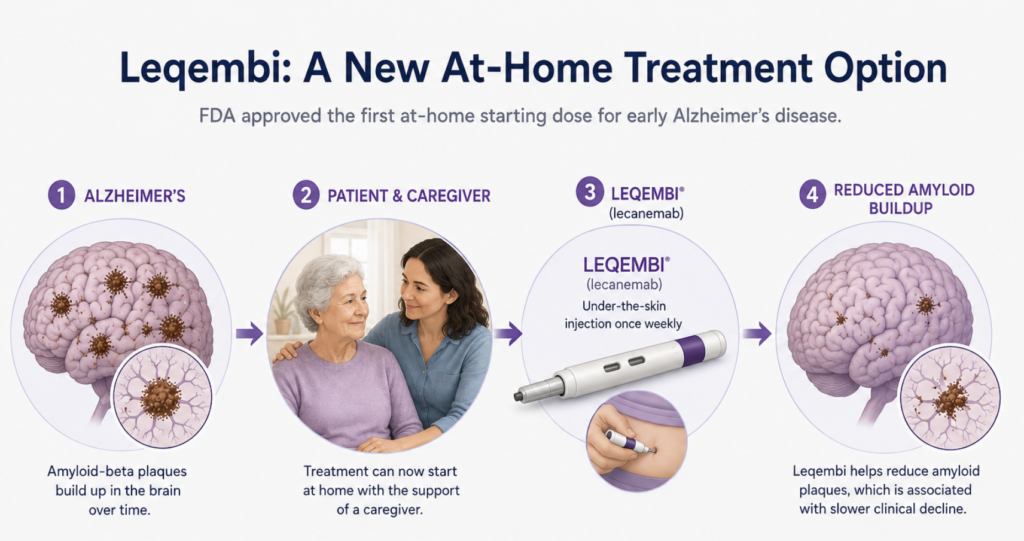
Fig 1: AI Generated Image
Important Safety Considerations
Although home administration makes treatment more convenient, Leqembi remains a powerful medication that requires careful medical supervision.
One of the most important potential side effects is amyloid-related imaging abnormalities (ARIA), a condition involving brain swelling or small areas of bleeding. Many cases of ARIA cause no symptoms and resolve on their own, but some patients may experience headaches, dizziness, confusion, vision changes, or, in rare cases, more serious neurological complications.
Because individuals who carry two copies of the APOE ε4 (2) gene have a higher risk of developing ARIA, healthcare providers are strongly recommended to perform genetic testing before starting treatment. This information helps patients and physicians better understand the potential risks and make informed treatment decisions.
Patients taking blood-thinning medications may also have an increased risk of bleeding-related complications, making careful evaluation by a healthcare provider especially important before beginning therapy.
Who Is Eligible?
Leqembi is not intended for every person living with Alzheimer’s disease. The treatment is approved for adults with early Alzheimer’s disease, including those with mild cognitive impairment or mild dementia, who have confirmed amyloid pathology. A neurologist or other qualified healthcare provider can determine whether a patient meets the appropriate criteria for treatment.
A Step Toward Empowering Families
More than 6.5 million Americans are living with Alzheimer’s disease, a condition that gradually affects memory, thinking, and independence. While the new home injection does not cure Alzheimer’s disease, it represents an important advancement in making treatment more accessible and less burdensome for eligible patients and their caregivers.
By reducing the need for frequent clinic visits from the very beginning of therapy, this FDA approval (3) gives families greater flexibility and allows many patients to receive treatment in the comfort of their own homes.
If you or a loved one has been diagnosed with early Alzheimer’s disease, speak with your neurologist or healthcare provider to determine whether Leqembi and the newly approved at-home injection option may be appropriate for your individual situation.
References:
1. https://www.alz.org/alzheimers-dementia/treatments/lecanemab-leqembi
2. Raulin AC, Doss SV, Trottier ZA, Ikezu TC, Bu G, Liu CC. ApoE in Alzheimer’s disease: pathophysiology and therapeutic strategies. Mol Neurodegener. 2022 Nov 8;17(1):72. doi: 10.1186/s13024-022-00574-4. PMID: 36348357; PMCID: PMC9644639.
3 https://www.fda.gov/drugs/news-events-human-drugs/fda-approves-first-home-starting-dose-alzheimers-disease-treatment
Leave a Reply