
Over the past several months, I’ve found myself deep in the literature of some of the world’s most remarkable longitudinal studies. Like most of us in clinical research, I was initially drawn to their findings. But the more I read, the more I became fascinated by something else entirely: their extraordinary ability to observe human life across generations.
Few areas of science demand the same level of patience and commitment as longitudinal research. They ask investigators to invest not in years, but in decades. They preserve questions long enough for children to become parents, for societies to transform, and for entire generations to pass before the full scientific value of the data becomes apparent.
Perhaps that’s why these studies have shaped our understanding of human health so profoundly.
Think of the Harvard Study of Adult Development, which has followed participants since 1938 and has provided remarkable insights into aging, relationships, and psychological well-being. Or the Dunedin Study, which has demonstrated how childhood experiences shape adult health and functioning. Cohorts like ALSPAC, Add Health, and the ABCD Study have completely transformed how we look at development, mental health, and resilience just by staying with the same individuals over a lifetime, rather than relying on isolated snapshots.
As I read, I found myself appreciating a specific strength that often goes unnoticed: their consistency.
The ability to ask comparable questions across decades allows researchers to distinguish historical events from life-course change. It enables us to separate what changes because people age from what changes because societies evolve. Without that continuity, many of the discoveries that now anchor modern medicine and psychology simply wouldn’t exist.
One of the remarkable strengths of longitudinal studies is that they do more than follow individuals through time. They also document how individuals move through changing historical contexts. Participants experience new technologies, changing family structures, economic recessions, pandemics, and cultural shifts that could not have been anticipated when many of these studies began. In many ways, longitudinal cohorts capture the intersection between human development and societal change.
But the more I reflected on that success, the more another thought began to emerge. Not because I thought these studies were missing something, and certainly not because I questioned their methods. Quite the opposite. Their success made me wonder about our future.
How Longitudinal Research Studies Capture Changing Human Experiences
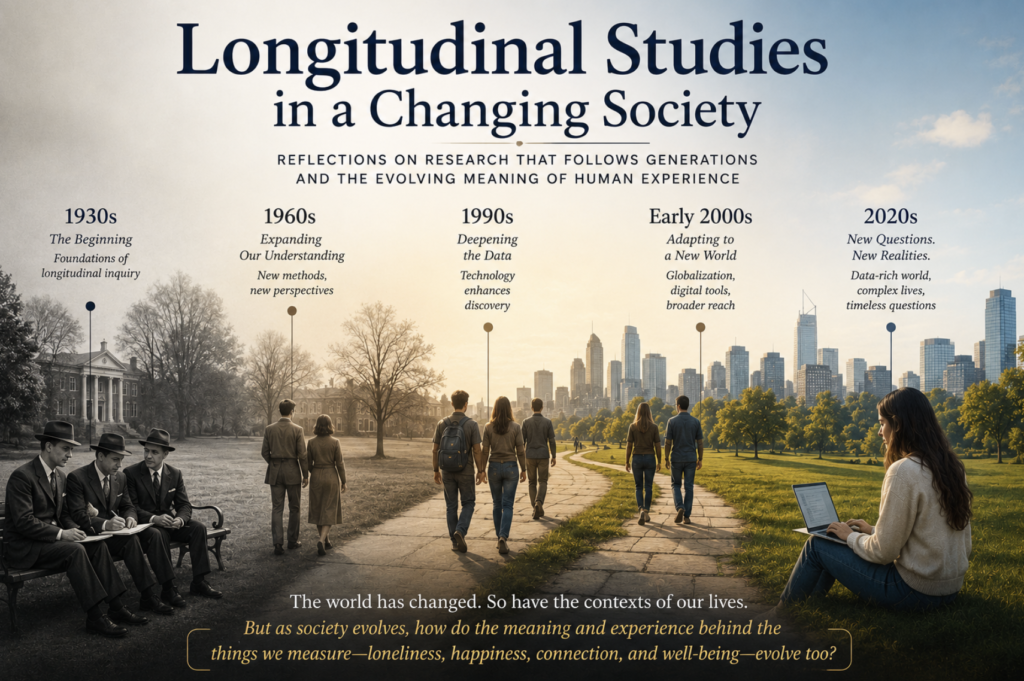
When the Harvard Study began in 1938, relationships were experienced in a world that looked nothing like ours. Communication meant face-to-face conversations, handwritten letters, or the occasional telephone call. Communities were defined entirely by geography. Workplaces, neighborhoods, and local schools were the literal spaces where relationships lived.
Today, those spaces have expanded in ways that would have been difficult to anticipate when many of these landmark studies began.
Families stay connected across continents in real-time. Online patient communities bring together people who may never meet in person, yet who share deeply meaningful support. Remote work has rewired professional relationships, and healthcare regularly extends beyond clinic walls through telemedicine. More recently, artificial intelligence has begun entering daily life as an educational resource, a sounding board, and, for some, even a source of reflection or emotional support. For many participants entering contemporary cohorts, these experiences are no longer exceptional they are part of everyday life.
None of this means technology has replaced human intimacy. Nor does it mean a digital interaction carries the exact same weight as a face-to-face connection. Those are empirical questions that we need to study rigorously, not make assumptions about.
Instead, my question is much simpler: As society evolves, do the lived experiences behind the very things we measure evolve too?
Take friendship. I have no reason to believe friendship is any less vital today than it was eighty years ago. But the contexts through which people experience it have expanded. Whether those newer contexts provide the same protective effects observed in traditional forms of social connection remains an open empirical question. A meaningful friendship today might begin in a digital support group, be sustained over years of video calls, and thrive in shared virtual spaces.
The core human need may remain the same. Its expression appears to be changing.
The same thought applies to community, belonging, social support, and loneliness. These remain some of the most powerful predictors of health we have. Yet the environments where patients actually feel these things are shifting every day alongside technology, culture, and work.
AI Generated- Longitudinal Studies
The Next Question for Longitudinal Studies
As researchers, we have consistently demonstrated an extraordinary ability to adapt our methods. Modern longitudinal cohorts are already incorporating incredible tools such as neuro-imaging, genomics, wearables, and digital tracking that would have seemed like science fiction a few decades ago.
But reading these studies made me wonder if a parallel conversation needs to happen.
Not about replacing our validated instruments. Not about abandoning decades of carefully harmonized data. It’s simply about periodically pausing to ask ourselves: Do the questions on our forms still capture the realities of the world our participants actually live in?
I don’t ask this out of skepticism. I ask it because the history of science reminds us that our understanding of human experience often evolves alongside society.
Maybe the data will show that these core constructs are remarkably stable and resilient to environmental shifts. Or maybe we’ll find that new contexts require us to add supplementary ways of looking at familiar concepts. Either outcome would deepen our understanding of human health and human experience.
One of the qualities I admire most about longitudinal research is its humility. It recognizes that meaningful scientific questions can’t always be answered within a single grant cycle or even a single career. It requires generations of investigators willing to observe patiently before drawing conclusions.
Perhaps the greatest contribution of longitudinal science is not simply that it follows people across time. Perhaps it is that it reminds us that people never change in isolation they change alongside families, cultures, technologies, and societies. As those societies continue to evolve, I find myself wondering whether one of the next great questions for longitudinal research is not simply what we measure, but how we ensure that the questions we ask continue to reflect the realities of the generations we study.
Further Reading
This reflection was inspired by landmark longitudinal cohort studies that have shaped our understanding of human development, aging, relationships, and mental health.
1. Casey BJ, Cannonier T, Conley MI, Cohen AO, Barch DM, Heitzeg MM, Soules ME, Teslovich T, Dellarco DV, Garavan H, Orr CA, Wager TD, Banich MT, Speer NK, Sutherland MT, Riedel MC, Dick AS, Bjork JM, Thomas KM, Chaarani B, Mejia MH, Hagler DJ Jr, Daniela Cornejo M, Sicat CS, Harms MP, Dosenbach NUF, Rosenberg M, Earl E, Bartsch H, Watts R, Polimeni JR, Kuperman JM, Fair DA, Dale AM; ABCD Imaging Acquisition Workgroup. The Adolescent Brain Cognitive Development (ABCD) study: Imaging acquisition across 21 sites. Dev Cogn Neurosci. 2018 Aug;32:43-54. doi: 10.1016/j.dcn.2018.03.001. Epub 2018 Mar 14. PMID: 29567376; PMCID: PMC5999559.
2. Add Health (The National Longitudinal Study of Adolescent to Adult Health)
3. Avon Longitudinal Study of Parents and Children
Leave a Reply